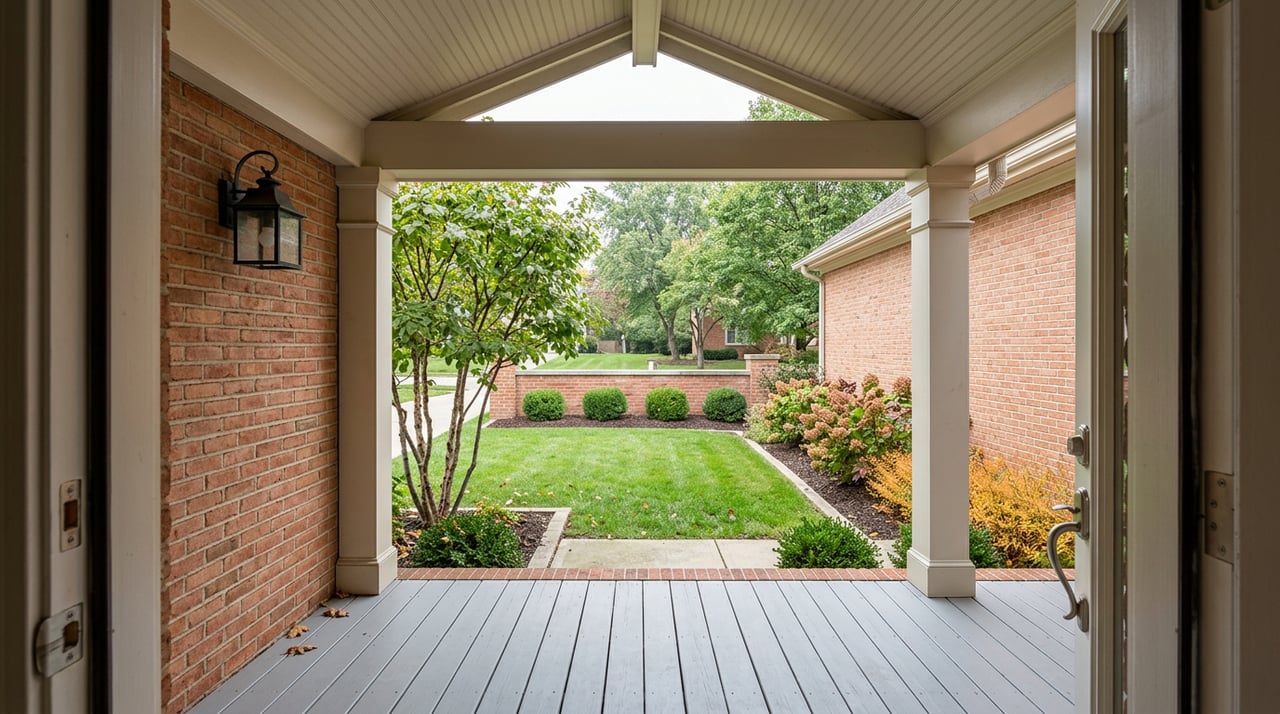
Selling an Older Home in Downtown Naperville: What the Historic Boundary Means
Walk a few blocks from Wright Street toward the river and you'll cross a boundary you can't see on any street sign. On one side, the City of Naperville's regulations for historic districts and landmarked properties mean a home built in 1910 can sit for a hundred years without a builder ever getting permission to touch its exterior in a way the city doesn't approve first. Three blocks over, a similar home from the same era might be gone within eighteen months, replaced by 4,500 square feet of new construction selling for well over $2 million. Same downtown. Same era of housing stock. Completely different set of rules.
That line is the Naperville Local Historic District, and it explains something the headline numbers on Downtown Naperville can't explain on their own.
Over the three months ending in May 2026, the median sale price in Downtown Naperville reached $960,000, up 28 percent from the same period a year earlier. The median price per square foot hit $508, up 41.5 percent year over year. Compare that to Naperville as a whole, where the median price per square foot over the same window sat around $273. Downtown isn't just outperforming the rest of the city. It's behaving like a different market entirely.
A 41.5 percent jump in price per square foot in a single year is not what ordinary appreciation looks like, even in a competitive suburb. That kind of swing usually means the mix of what's selling has changed, not that every home in the area suddenly got more valuable. And in Downtown Naperville, the mix has changed: a growing share of what's closing is brand new construction on lots where an older home used to stand, priced at new-construction rates, sitting next to the original housing stock that's still trading closer to what it always has.
The historic district boundary is the reason that mix shift is concentrated downtown specifically, rather than spread evenly across the city.
The Naperville City Council created the Local Historic District in 1986. It covers roughly 320 properties, most of them houses, plus part of the North Central College campus. A federal historic district covering similar ground was established back in 1977. When the local designation was proposed, it was controversial. Only about 16 percent of the property owners inside the proposed boundary actually supported it at the time.
Whatever the politics, the effect has held for four decades. Since 1986, only about five complete demolitions have happened inside the district. The city's own Historic Building Design and Resource Manual describes tearing down an existing structure to build a new primary home in the district as something that is, in its words, highly discouraged. Any exterior change, addition, or demolition inside the district requires a Certificate of Appropriateness from the Historic Preservation Commission, which reviews applications under Title 6, Chapter 11 of the Naperville Municipal Code and meets on a bi-monthly schedule. An approved COA is good for three years.
This isn't a historical footnote. At its December 4, 2025 meeting, the commission took up a Certificate of Appropriateness request for a property on North Wright Street and a separate request to designate the First Congregational Church on East Benton Avenue as a local landmark. Those are real addresses moving through a real public process, on a schedule that repeats every other month.
Outside that mapped boundary, the story is different. Builders working in Naperville have described teardown projects as one of the fastest-growing ways to get a new custom home built in the city, precisely because there's so little raw land left. The neighborhoods most often named as active teardown territory include East Highlands, West Highlands, Cress Creek, the blocks around Downtown Naperville that sit outside the protected core, and pockets east and south of the river. Some listings for those lots make the distinction explicit in their own marketing, advertising that a property carries no historic district restrictions as a selling point, freeing a buyer to design and build without the approval process that would apply a few blocks away.
If you own an older home near downtown and you're thinking about selling, the historic district question isn't a formality. It changes who's likely to buy your house and what they're likely to do with it.
| Inside the Historic District | Outside the boundary | |
|---|---|---|
| Demolition | Highly discouraged; roughly five since 1986 | Common; among the fastest-growing building paths in the city |
| Exterior changes | Require a Certificate of Appropriateness from the Historic Preservation Commission | Standard permitting only |
| Likely buyer | Preservation-minded owner-occupant, renovator | Custom home builder, buyer planning a rebuild |
| Marketing angle | Character, craftsmanship, walkability, established streets | Lot size, tear-down potential, new-construction upside |
| Pricing comparable to | Other district homes, valued for condition and character | Land value plus what a builder can put on it |
A home inside the district competes on charm, condition, and how well it's been maintained within the design guidelines the city already has on file. A home just outside competes on lot dimensions, drainage, utility access, and how much house a builder can fit on it under current setback and coverage rules. Pricing one like the other is how sellers leave money on the table in either direction, either underpricing a teardown-eligible lot because the seller compared it to protected-district homes, or overpricing a historic-district home because a builder's recent sale down the street set expectations it can't legally meet.
None of this means Downtown Naperville values are inflated or that the 28 percent median jump is somehow fake. It means the number is describing two different products under one geographic label. If your home sits inside the historic district, that 41.5 percent per-square-foot increase downtown largely isn't about your house. It's about new construction elsewhere in the same zip code changing the mix behind the median. Your home's value still depends on the same things it always has: condition, updates, and how well it presents against other district homes, not against a builder's price sheet three streets away.
If your home sits outside the boundary, on the other hand, that same headline number might genuinely apply to you, and pricing it like a traditional resale rather than land with upside could mean settling for less than a builder would actually pay.
Either way, the fix is the same. Find out which market you're actually in before you decide how to price, stage, and market the sale.
Getting that answer right, and presenting a home so the right buyer pool actually sees its value, is exactly the kind of local, hands-on work Sandy Hunter Homes does for Naperville sellers. Reach out for a walkthrough of where your address falls and what that means for your sale, or start with a Get Your Instant Home Valuation to see where your number stands today.
Does being inside the historic district lower my home's value? Not based on what the data shows. District homes are valued on their own terms, for character, condition, and walkability, not against teardown pricing. The district affects what you can do with a property more than what it's worth as-is.
How do I find out if my home is inside the boundary? The city's Historic Preservation Commission, reachable through the city's planning staff, maintains the current district map and property list. With the property survey update now underway, confirming your status directly rather than relying on an old map is the safer move.
What if I want to renovate rather than sell to a builder? That's exactly the buyer pool a historic-district home should be marketed to. The Certificate of Appropriateness process governs exterior changes, not interior updates, so plenty of renovation is possible inside the district, though exterior work must go through the commission's review first.
This article is general information, not legal, tax or financial advice. Consult a qualified professional about your situation.
October 15, 2026
October 8, 2026
October 1, 2026
September 24, 2026
September 17, 2026

September 10, 2026
September 3, 2026
September 3, 2026
September 3, 2026
Whether working with buyers or sellers, Sandy provides outstanding professionalism in making her client’s real estate dreams a reality. Call Sandy today to schedule a private showing.
Get In Touch To Learn More