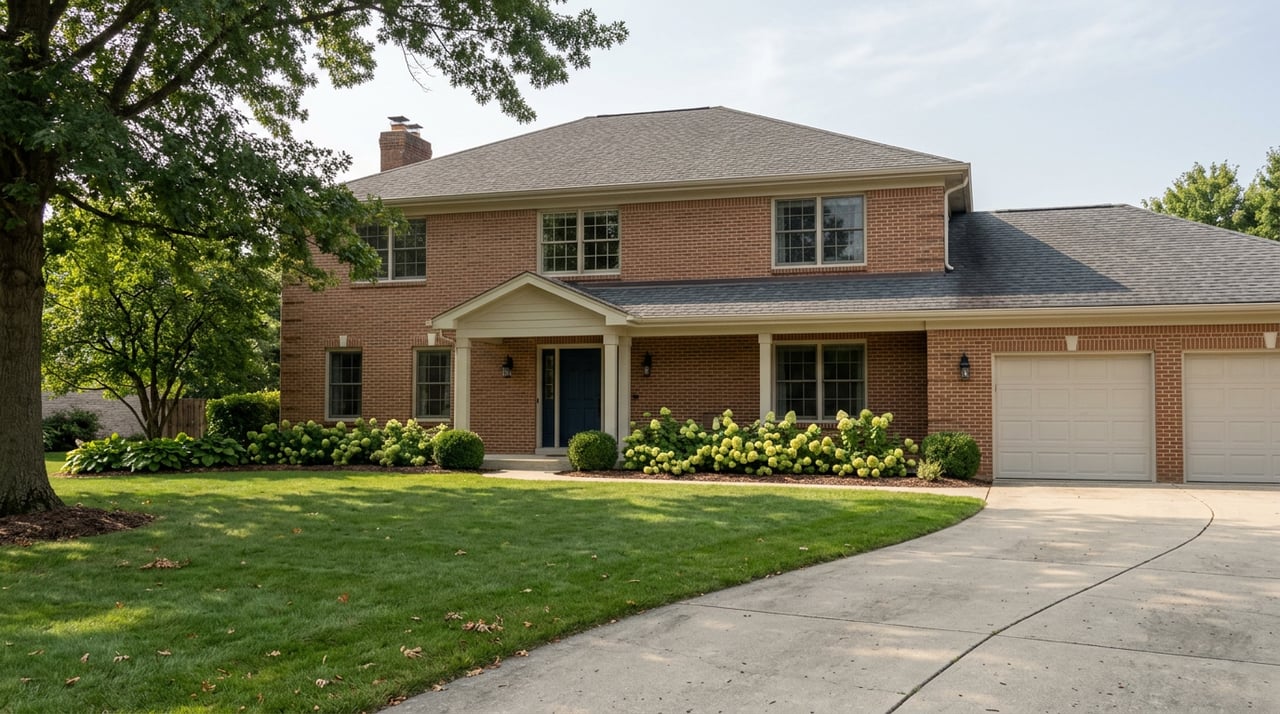
Why the Same Naperville Zip Code Can Carry Two Different Tax Bills
A buyer comparing two nearly identical listings in Naperville's 60564 zip code, same price, same square footage, same builder, can end up with tax bills that differ by hundreds of dollars a year and never know why until the first bill arrives. The zip code tells you the mail carrier. It does not tell you which county sent the bill.
Naperville sits across the DuPage and Will county line, and that line cuts through more than open farmland on a map. It runs through zip codes, through subdivisions, occasionally through streets that look identical from curb to curb. A house's tax rate, its school levy, even the calendar for appealing an assessment, all depend on which side of that line the parcel actually falls. The median price you see on a listing describes the house. It says nothing about the county collecting the check.
Most buyers use zip code as shorthand for neighborhood, and in most cities that shorthand holds up. In Naperville it doesn't always. Property tax data from Ownwell shows that homes in the 60564 zip code carry a median effective rate of 2.23 percent on the DuPage County side, but the same zip code shows a 2.37 percent median rate on the Will County side. Same five digits on the envelope, different treasurer cashing the check.
It isn't an isolated glitch in one zip code. The 60540 zip code shows up on both counties' tax rolls as well, with DuPage-side bills running as high as $9,936 in that zip while the Will County portion of 60540 posts a lower 2.13 percent effective rate. A buyer who filters listings by zip code alone, assuming it functions as a clean proxy for tax exposure, is working from an assumption the data doesn't support.
Zoom out from zip codes to the two counties as a whole and the gap gets easier to see in dollars. Ownwell's tax data for Naperville breaks out cleanly by county:
| DuPage County side | Will County side | |
|---|---|---|
| Median effective tax rate | 2.05% | 2.35% |
| Median annual tax bill | $9,065 | $12,734 |
That's a difference of roughly $3,700 a year between the county-side median annual tax bills for Naperville. Over a seven-year hold, the gap compounds into real money, money that never shows up in the list price and rarely comes up until a buyer is deep enough into a purchase to be comparing loan estimates.
The rate difference isn't arbitrary. Illinois taxing bodies each set their own levy, and DuPage and Will counties layer different school districts, park districts, and special service areas on top of the base county rate. A parcel's total bill is the sum of everything serving that specific address, not a single county-wide number.
The City of Naperville's own breakdown of township boundaries shows exactly where the county split runs on the ground. North of 87th Street and west of Washington Street sits Naperville Township, in DuPage County. North of 87th and east of Washington is Lisle Township, also DuPage. Cross south of 87th Street and the same city becomes Will County territory: Wheatland Township west of Washington, DuPage Township (the name is a coincidence, the county is not) east of it. A small sliver in the far northwest corner falls into Winfield Township.
That means two intersecting streets, 87th and Washington, do most of the work of deciding which county collects a homeowner's tax bill, which board hears an appeal, and which assessor's office holds the property record card. A buyer touring homes across that boundary is crossing a governmental line as real as a state border, even though nothing about the streetscape announces it.
The county line isn't the only overlay a Naperville buyer needs to track. Naperville Community Unit School District 203 generally covers the central, north, and east parts of the city, while Indian Prairie School District 204 covers the south and southwest. That boundary roughly tracks the county split but doesn't map onto it perfectly, which means a buyer can't assume county and school district travel together.
Both districts have raised their levies. District 203's board adopted a 3.8 percent levy increase for the 2025 tax year, bringing the total levy to about $315.13 million, according to NCTV17's coverage of the December 2025 board meeting. District 204 approved a 3.4 percent increase to existing homeowners' share of its levy in the prior cycle, per reporting from Naperville Patch. Since school levies are typically the largest single line item on an Illinois property tax bill, which district serves a given address does as much to shape the final number as which county collects it.
The split follows a homeowner well past closing day. If an assessment looks too high, the process for challenging it depends entirely on which county holds the parcel record, and the two counties don't run on the same clock.
Will County's official complaint period for the 2026 assessment year ran from August 12 through September 14, 2026, a window that has already closed as of this writing, according to Younis Law Group. DuPage County doesn't work off one fixed date at all. Each of DuPage's townships publishes its own assessment roll on its own schedule, and that publication date starts the appeal clock for that township alone, typically landing sometime in the fall. A homeowner on the DuPage side of Naperville who assumes the Will County deadline applies to them could either miss their real window or panic unnecessarily about one that already passed.
For sellers thinking about pricing and disclosure, and for buyers thinking about carrying costs, that mismatch is worth building into the timeline rather than discovering after the fact.
Does the county line follow subdivision boundaries? Not reliably. The dividing streets are 87th Street and Washington Street, which can run through the middle of a zip code or near the edge of a subdivision rather than around it cleanly.
Can a homeowner choose which county collects their taxes? No. The county is determined by the parcel's physical location, not by preference, mailing address, or which office a homeowner would rather deal with.
How do I find out which county and township a specific Naperville address falls in? The most reliable path is a direct parcel lookup through DuPage County's or Will County's assessor site, since school district and municipal boundaries can differ from the county line.
None of this changes what makes a Naperville house worth buying. It changes what "worth" actually costs to hold onto once you own it. A listing price is one number. The county, the township, and the school district each add their own, and none of them show up on the sign in the yard.
If you're comparing homes across Naperville's tax lines, or trying to understand what a specific address will actually cost to carry, Sandy Hunter Homes can walk through the county, township, and school district specifics for any property you're considering. Get Your Instant Home Valuation to see where your own address falls before you make your next move.
This article is general information, not legal, tax or financial advice. Consult a qualified professional about your situation.
October 15, 2026
October 8, 2026
October 1, 2026
September 24, 2026
September 17, 2026

September 10, 2026
September 3, 2026
September 3, 2026
September 3, 2026
Whether working with buyers or sellers, Sandy provides outstanding professionalism in making her client’s real estate dreams a reality. Call Sandy today to schedule a private showing.
Get In Touch To Learn More